
CBRS with MOCN as a Coverage Solution
CBRS with MOCN as a Coverage Solution
Todd Landry
June 11, 2026
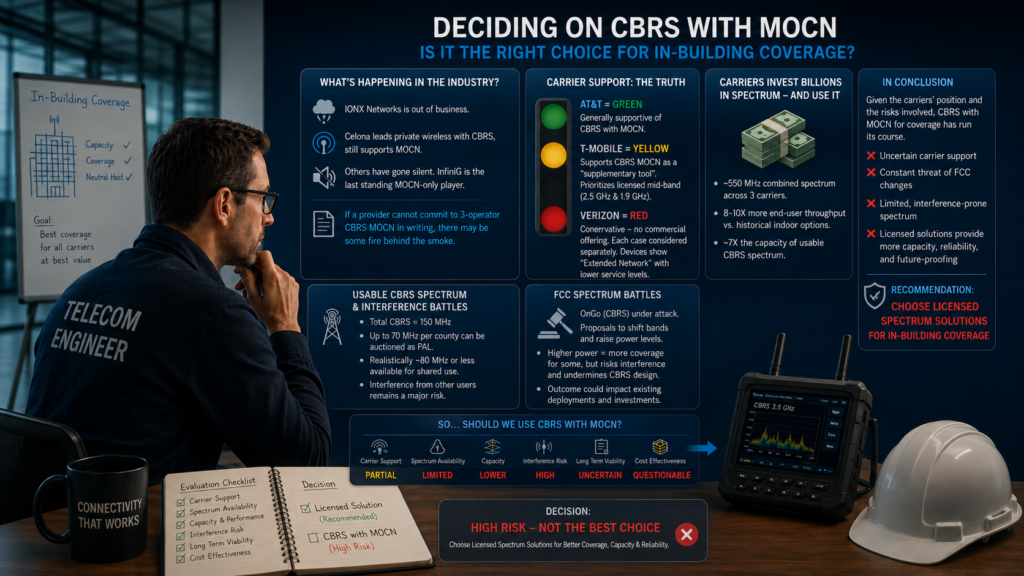
Perhaps the best indicator as to whether the use of CBRS spectrum and MOCN Gateways for three carrier coverage is a look at what’s going on in the industry itself.
Where there is smoke, is there fire?
IONX Networks domain is now parked and the company apparently no longer in business, Celona seems to be primarily leading efforts in private wireless with CBRS but still will support MOCN. Others that have entered the MOCN race seem to have gone silent. The last standing is InfiniG, who still promotes the ability to bring all the carriers on which is understandable as this is their only product offering.
A simple method, if you are a buyer, and discussing three operator CBRS with a provider is to basically force them to contract it in writing. If they cannot then perhaps there is some fire among the smoke.
Where are the carriers on this really? My simple conclusion is (stop light simplicity):
AT&T = Green, T-Mobile = Yellow, and Verizon = Red.
Verizon’s position in their documentation states “they are conservative relative to support”, which should be taken as there is no commercial offering and each case is an entirely separate consideration. Moreover, they state that if used at a site the Verizon phones will show “Extended Network” on the device screen because service levels are expected to be below those of the MNOs licensed spectrum service, and they do not want their brand associated with CBRS service levels.
T-Mobile just over a year ago informed providers and vendors it works with to “prioritize” its licensed mid-band spectrum, mostly at 2.5 GHz, plus at 1.9 GHz, for new shared infrastructure projects. That said, their comments to CBRS MOCN were, “We continue to support CBRS-based MOCN and neutral host networks, however, we are encouraging our vendors and partners to prioritize licensed mid-band FDD/TDD spectrum over CBRS.” They go further to define it as a “supplementary tool” and “The reason is straightforward: licensed spectrum delivers the certainty, performance, and scale required for 5G, while CBRS – because of its unlicensed nature, uncertain availability, and limited support in the 5G roadmap – is better suited as a supplemental tool. As mobile traffic continues to accelerate on 5G, our focus is on ensuring T-Mobile customers get the most consistent, high-quality experience.”
$Billions on Spectrum, I want to Use It.
Putting yourself in the carrier’s position – you spent billions on spectrum and have significant capacity compared to CBRS – it logical that you would want your spectrum to be utilized, and I think this is a logical position of all carriers.
The combination of spectrum across the three carriers sums up to some 550MHz of spectrum, increasing the end user throughput spectrum by 8-10 times that of historical spectrum options used for indoors. Moreover, this is some 7 times the capacity of the useable CBRS spectrum for indoors.
Usable CBRS Spectrum and Interference Battles
CBRS spectrum is touted as a shared spectrum, and deployments require sites to register for use of the channels via Spectrum Access Systems (SAS). The base SAS systems made no distinction as to any interference, meaning one provider could turn on the same channels as your systems and directly interfere, making coordination an important part of a provider’s efforts.
The total CBRS spectrum is 150MHZ, but by launch CBRS has auctioned up to 70MHz of the spectrum in each county to operate under a Priority Access License (PAL), which when used requires any other system to vacate those channels. One can easily argue that the amount of spectrum you can depend on them is 80MHz, and in some cases due to where the PAL channels line up it would be even less for a coverage solution.
FCC Spectrum Battles
The CBRS spectrum and its main supporting group OnGo Alliance have been under attack, first by AT&T with proposals to shift CBRS to an entirely different band, and more recently proposals to raise the power levels. Advocates of higher power include certain mobile operators, as it would align the power limits closer to their licensed spectrum and allow for great coverage in certain uses. Opponents include a wide range of organizations including Amazon suggest that an increase is allowed power would compromise lower power implementations and threaten the original design premise of CBRS.
Does this put certain risk into the use of CBRS spectrum? Certainly, if the powers side with the changes proposed a deploy solution could experience interference and the investment could be impacted if not rendered unusable.
Important Take Aways
Given the carriers position one could easily conclude that MOCN for coverage using CBRS has run its course. It’s risky, as the spectrum is under constant threat by others seeking FCC changes for its use, it’sdifficult to get all three carriers on board with it and does not have a clear long term support method for future G’s. All this when there are very new, clean, and supports platforms for three carrier coverage with a long-term support strategy.
Choose wisely, Choose smartly.