Determining what Your Building Needs for Cellular Wireless
Determining what Your Building Needs for Cellular Wireless
Todd Landry
June 22, 2026
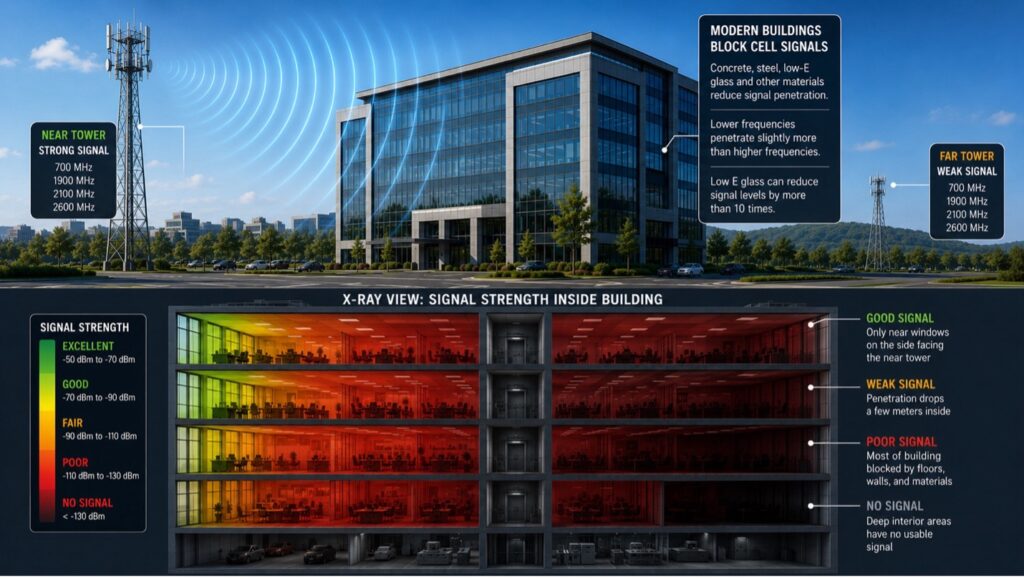
An MRI on your body identifies issues and shows doctors what to operate on. A Site Benchmarking Analysis of your building is like an MRI for cellular coverage.
It seems logical that cellular towers outside should provide signal right into your building, however most buildings today are constructed of materials that hinder or attenuate the cellular signals and keep them from being useful inside of buildings. This is a key reason why an inbuilding cellular system, commonly known as a Distributed Antenna System, provides enhanced services for mobile users when in buildings.
For reference, materials such as drywall, glass, concrete or brick, and metal all reduce or block signal from as little as 2dB up to 50dB, which is up to 16 times signal reduction. Many building now utilize Low-E glass on the outside which has metalized layers embedded in the glass, these create a barrier around the building that alone reduced signal by 13 times.
The nature of signal propagation is such that lower frequencies such as the 700 to 850MHz signals are better at making their way through these materials than the more common mid-band frequencies used, which are in the1.7 to 3.8GHz range. Carrier’s lower band are smaller, so don’t have the capacity demands by mobile users, whereas mid-band frequencies have much more capacity (as much as 40 times) to meet the real needs of a mobile first workforce and tenant expectations.
What is Benchmarking Analysis and Why
A process of measuring the level of signals (power levels, noise levels) inside a building provides a view of the current state of signal in that building. The process uses specialized equipment that can identify specific frequencies used by each carrier and provides an essential heatmap of all areas of the building.
The results tell engineers several important factors for the design of an inbuilding system, including areas that have clear gaps in signal, areas where signal is good, and what levels the signals and the noise in the signal are at. It does this by every frequency band across all the carriers. As a result, this data is an input into an RF design planning phase, using a tool such as iBwave engineers can then ensure the planned radio design meets the criteria that each mobile carrier expects to ensure the proper levels that will enable transparent handovers from outdoor networks and clean signal (minimum noise) such that the maximum performance is achieved.
The Good News behind External Signal Blocking
When RF designers see a building that uses Low-E glass they smile. Why? Cellular networks are designed as cells (distinct geographic areas of coverage) that essentially touch each other (cell edges). Mobile phones move among these cells and are always communicating (from a control perspective) with multiple cell sites, then they coordinate which cell they should be using and the process of moving from one to another is known as a handover (not roaming as some refer to it as). Since cells use the same frequencies one cell can create noise to another cell, and the design process to minimize noise at cell edges is part of the design process.
As a result of the above, when a building has an essential glass blanket of attenuation externally it makes it easier to create a clean cels edge – inside the building versus outside the building. You may have experienced a scenario where you have poor signal in a building and then when you get close to the windows you can connect, usually just somewhat.
So, external signal blocking is good for indoor radio (RF) planning!
Coverage versus Capacity
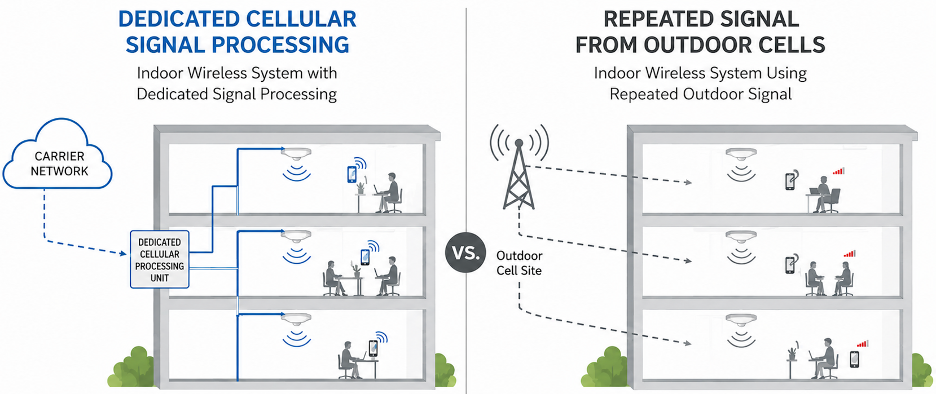
For mobile phones there is a distinct difference in coverage planning versus capacity planning. Each cell in a cellular network shares its capacity (think total Mbps throughput) with all the mobile devices within that cell (this is also referred to as a sector). So, the more users in a cell the lower the average throughput experience. When an in-building environment has many people (high occupancy) using mobile devices and especially when the business expects higher throughput on the mobile devices, then a dedicated cell in the building with its own signal processing (its own capacity) is an important consideration. A coverage approach can be deployed which can increase the signal levels but still shares the capacity from an outdoor cell. As a result, the indoor network is not a separate cell but instead is an extension of an outdoor cell. The outdoor cell used for each carrier can be selected but the amount of capacity can vary widely depending on the number of mobile devices in those shared outdoor cells.
Repeating Signal or Dedicated Signal
Aligned with Coverage versus Capacity engineers seek to understand the occupancy of a building and the expectations of the mobile usage, as a result they may recommend dedicated signal on the cellular system, versus sharing with the outside cell as described above.
The choice of which approach to utilize is a determination of how much capacity is needed. Both solve for coverage, but dedicated signal processing provides dedicated capacity inside the building. Note that this can be different for each carrier, where one may not be that prevalent in terms of mobile devices, yet another may have a dominate number of devices in the building, thus a dedicated signal for the later may make sense.
Passive Signal Distribution versus Active Signal Distribution
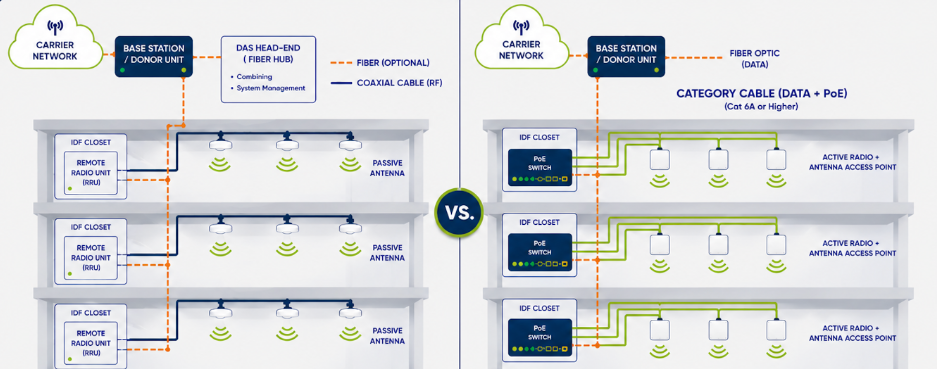
When it comes to systems for cellular signal distribution in a building there are several options available, and different topologies to consider. All of them effectively distribute signal throughout the building and can utilize dedicated signal processing as described above. However, when it comes to the final meters of signal delivery to the antenna in the ceilings of a building there are some differences to consider.
A more traditional approach uses coaxial cables run through the ceilings, which are then connected to antennas. This approach is known as passive distributed antennas. The merits of this approach are that the coaxial system and its antennas have no active electronics that need to be powered or that can more easily break, they can also be wide-band (many frequencies) which allows the addition of new bands without changing these areas of the building, making it more efficient and less disruptive.
Some systems, including those described as Distrbuted Antenna Systems (DAS) and others described as Cellular Access Points, can use category cabling (CAT6A) with Power Over Ethernet (POE) or fiber optics with DC power to connect to these lower power radios with built-in antennas. The merits of these are they are more aligned with what IT teams are familiar with and IT teams can pull the category cables and/or fiber as it is something they are well versed in. Note that the costs can be much lower for the cabling install, easier to move if building changes happen. However, it also means that active electronics will be mounted in the ceiling areas, and much like Wi-Fi these may need replacing if they become faulty and would need to be replaced (depending on the system) if new bands are added.
Important Take Aways
When it comes to choosing the system and the topology for your building there are only bad choices when the objective for mobile users is not well understood. Unfortunately, there are many providers that will not actively ask the right questions to help you review the needs of your building and to establish the basis for which approach makes the most sense. Moreover, some of them bias their recommendations on when they have access to. This approach is not in your best interest. Seek providers who are well versed in all options, who have the advisory staff to work with you on your environment, help you do the mobile demand analysis, and recommend options that are right for your business.
Choose Wisely, Act Smartly.