Venue Wireless RETHINK — Season 1 : Episode 2 – Rethink How It Is Funded
Venue Wireless RETHINK — Season 1 : Episode 2 – Rethink How It Is Funded
Todd Landry
August 13, 2026
On June 29th, 2026, at the annual Sports & Entertainment Alliance for Technology (SEAT) Conference I presented to a cross section of this industry, including sports clubs, solutions providers, 3PO’s, wireless carriers, and sports venue consultants. The session was titled Venue Wireless RETHINK – a MASTERCLASS. While many of these topics could be controversial among different attendees, I was pleasantly surprised to see a cross-section of this industry response very positively and join in the idea that it is time for a rethink in this industry and the approach to selecting and delivering cellular wireless infrastructure.
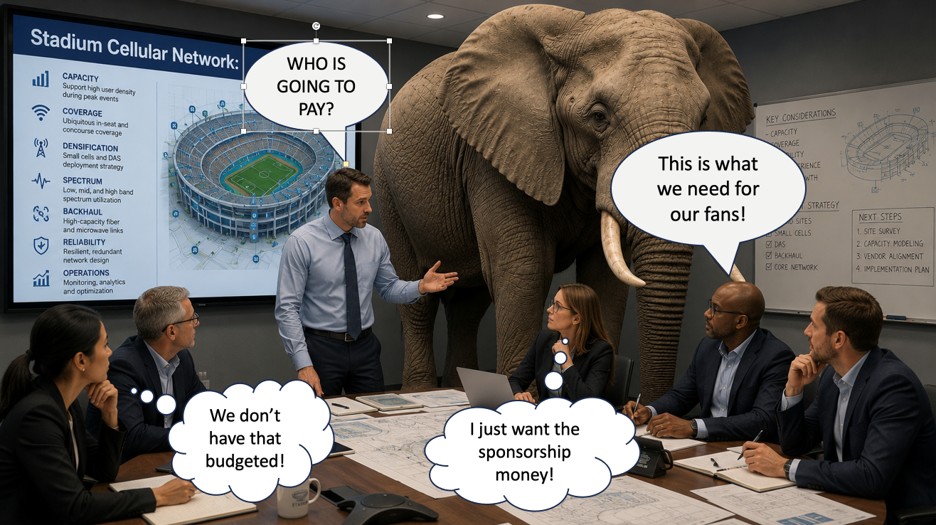
A somewhat comical image was used in the SEAT session presentation, openly declaring that “there is always this elephant in the room” – who is going to pay? The audience at SEAT was quick to align, agreeing that this is a major industry issue as we are in a state of transformation on funding wireless systems (aka the DAS) in sports venues. In short, the old business model is fracturing.
A Fracturing Business Model
It’s no secret, the world of expectations that the wireless carriers will pay for the wireless infrastructure and provide revenue streams is disappearing – and fast. The table was set years ago, when third-party operators (3POs) signed deals with large, prominent venues to control the rights to venue wireless, promising to recoup their costs—and in some cases, generate returns of as much as 300% of the system cost. Then came additional access revenue streams, followed by sponsorship opportunities. All of this added up to big dollars!
The traditional stadium distributed antenna system (DAS)[1] business was built on a simple premise: with wireless demand skyrocketing, deals were a rounding error on carrier P&Ls, very profitable for 3POs, and found money for the sporting community — the entire model was premised on the largesse of telecom companies that ignored the obvious conclusion that subscriber growth couldn’t last forever.
The foundation is now cracking. The cost of these licensed cellular DAS systems has grown[2] — early DAS deployments were in the range of a few million dollars, while some stadium deployments are in the tens of millions, with some NFL-caliber solutions costing well over $50 million. With their legacy macro wireless businesses under pressure, carriers aren’t willing – or are far less willing — to write the big checks to 3POs and venue operators. More recently the industry is seeing at least one carrier taking a strong and public position, drawing a line in the sand and even suggesting they would go dark in a stadium versus being held hostage.
In 2026 there are still major venues guided down these same old paths. This business model is becoming a relic of the past and is changing quickly. So, how do you plan? Who do you engage? How do you think differently?
If you are in the planning, build, or refurbish phases of your venue and this sounds familiar you may already be behind.
For starters, with wireless carriers no longer agreeing to fund these systems—and with demand for mobile connectivity continuing to grow—venues need to rethink their approach. If a venue is still in the early stages of planning, before drawings are even developed, it should be budgeting for wireless infrastructure as a utility, much like it does for power, water, and other essential services.
At the same time, these are expensive systems. Venues should seek wireless infrastructure partners that not only understand the technology, but can also provide long-term, as-a-service funding models that help manage the investment.
Lastly, wireless infrastructure is evolving to provide far more than mobile connectivity. It’s time for venues to seek partners who can help them plan for a future where the wireless investment supports multiple applications and services—and potentially creates entirely new revenue streams.
So, to that end it’s time to think of your wireless infrastructure not as a DAS, but as a Digital Services Platform – one that demands more from the infrastructure itself, from partners who provide strategy and planning, and from those who ultimately deliver it.
Watch for Episode 3 to Learn About RETHINKING PARTNER SELECTION
[1] A multi-carrier wireless RF repeater system that carriers were required to connect to in order to distribute spectrum throughout the stadium.
[2] Although as of late some DAS vendors are actively working to reduce costs and complexity of their offerings.