Venue Wireless RETHINK — Season 1 : Episode 5 – Spectrum: The Foundation
Venue Wireless RETHINK — Season 1 : Episode 5 – Spectrum: The Foundation
Todd Landry
September 3, 2026
On June 29th, 2026, at the annual Sports & Entertainment Alliance for Technology (SEAT) Conference I presented to a cross section of this industry, including sports clubs, solutions providers, 3PO’s, wireless carriers, and sports venue consultants. The session was titled Venue Wireless RETHINK – a MASTERCLASS. While many of these topics could be controversial among different attendees, I was pleasantly surprised to see a cross-section of this industry response very positively and join in the idea that it is time for a rethink in this industry and the approach to selecting and delivering cellular wireless infrastructure.
Season 1 : Episode 5 – Spectrum – The Foundation
This Episode
Skating to where the puck will be (thank you, Gretzky) we see that the shift in technology is significantly changing the needs of a stadium wireless. To enable wireless naturally you need air, or more aptly spectrum, that you can transmit over. The entire area of technology and the business of spectrum ownership is fascinating and an area that is healthy to understand in venue wireless strategy planning – so of course you should be thinking, where is the puck going to be! This episode will dig into some of this, but to be honest – it only scratches the surface.
Why is Looking at Spectrum Important?
Simply put, without spectrum, there is no wireless. One could easily conclude that the ownership of spectrum by a carrier (mobile wireless operator) — at least by FCC terms — is the single most important asset it has. The amount of spend on spectrum is substantial, and when considering that the T-Mobile acquisition of Sprint is arguably about access to Sprint’s spectrum, the total spend is over $152 billion over the past 10 years.
The Sprint merger ($40.8B, per T-Mobile’s SEC 10-K) is by far the single largest capital event in the chart — it alone exceeds everything AT&T spent on spectrum in the entire decade. In the chart below, the shaded green band between the dashed and solid T-Mobile lines represents the Sprint premium visually.
Verizon’s C-band gamble in 2021 ($45.5B) is the largest single auction spend in U.S. history and is what drives them to $52.6B cumulative. They deliberately sat out the 3.45 GHz auction and kept their 2026 AWS-3 spend targeted — just filling high-value urban gaps.
AT&T has been the most consistent but never dominant bidder participating across every auction window but never betting the house on any single one. Their 3.45 GHz spend ($9.1B in 2022) was their biggest single swing.
On an auctions-only basis (stripping Sprint), T-Mobile is the smallest spender of the three at $22.2B — reflecting their strategy of acquiring spectrum through the merger rather than competing aggressively at auction.
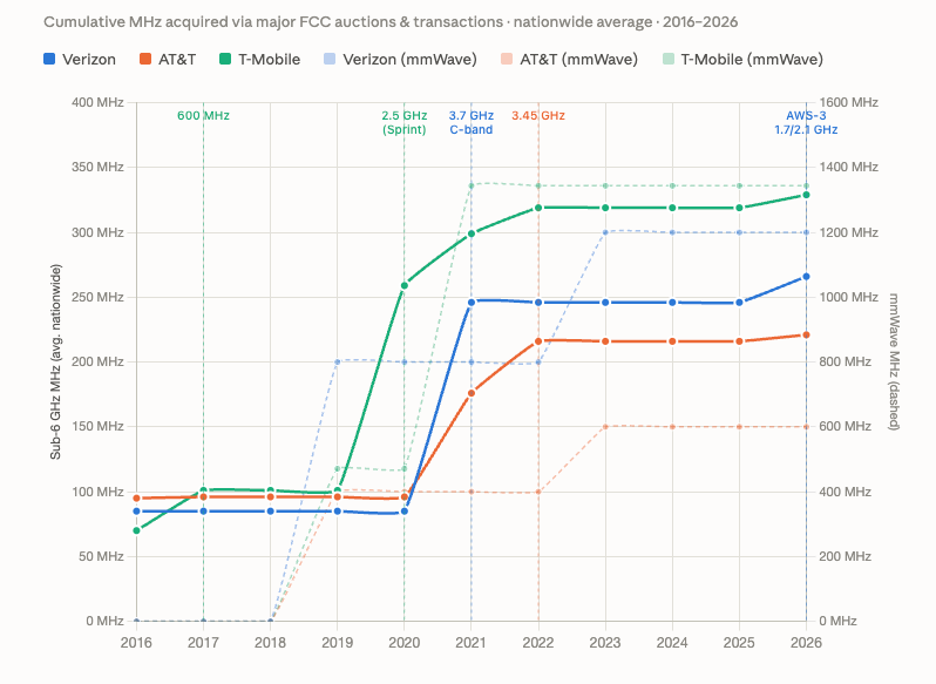
T-Mobile’s 2020 Sprint merger was the single biggest spectrum step-change of the decade adding ~158 MHz of 2.5 GHz spectrum in one move and vaulting them to a commanding sub-6 GHz lead they still hold.
Verizon went all-in on C-band in 2021 ($45.5B, 161 MHz average) to close the mid-band gap, then sat out the 3.45 GHz auction entirely in 2022. Their 2026 AWS-3 spending ($3.2B) was a targeted capacity layer for dense urban markets (NYC, Chicago, Boston).
AT&T is the most consistent acquirer, buying in every major auction, but never dominant in any single one. Their 3.45 GHz win (40 MHz, $9.1B) was their biggest mid-band move.
How Does Spectrum Equate to Speed (Megabits or Gigabits per Second)?
Getting data bits into a wireless transmission is a long-time science. One of the well-known theorems on this is the Shannon-Hartley theorem (often referred to as just Shannon). It defines how to determine the amount of error-free data that can be put into a wireless transmission. The mathematical equation looks like this:
C=W log2(1+S/N)
Shannon showed that channel capacity (C) – the achievable data rate in bits/s – is proportional to channel bandwidth (W) and logarithmically dependent on the Signal to Noise ratio (S/N). When you speak with RF people you will hear and see terms like RSRP and SINR. They are really talking about the amount of usable signal they can create in your venue for moving data over. At its roots is this calculation.
As an exercise, I asked Claude to create a simple calculator – check it out!. When you use certain parameters to get a feel for the speed you can get information like that in the example below. Note that this assumes 4 layers, or 4X4 MIMO connection, 100MHz of spectrum capacity (the standard channel bandwidth for things like C-Band), and expected noise of a stadium. Note, there are many calculators and a lot more that can go into this – so that this as an example – not as the purist’s calculation.
The 4G to 5G Technology Bandwidth
The world of LTE is one of 20 MHz channels. The world of 5G (New Radio or NR) is one of 100 MHz channels. Multiple channels can be combined, so it is not uncommon to have two 20 MHz LTE combined, and in 5G a 100 MHz channel combined with an 80 MHz (due to certain total available spectrum) – for simplicity take this as a shift from 40 to 180, or 4.5 times the capacity possible. Today, stadium solutions utilize many different bands, but arguably the future state will only need a select few bands to achieve the goals.
Non-Standalone 5G to Standalone 5G
It is often misunderstood that a 5G symbol on your phone still means today that behind the scenes the connection up to the network (uplink) and all phone controls are still 4G-based, only the downlink session is 5G (at least for some carriers). This is good for download capacity but doesn’t change the upload. More importantly, it means systems need both 4G and 5G bands support to operate. This is known as Non-Standalone (NSA). What’s changing? Within the next few years, most networks and their mobile phones will use 5G in both directions, resulting in a 100% 5G connection for both uplink and downlink. You will hear of this as “5G Stand Alone” or “5G SA”.
The Effect and Advancements of MIMO – Massive MIMO
I won’t serve its complexity justice here, but to keep it as simple as possible, MIMO equals multiple wireless connection paths using the same frequency but on different antennas that are separated spatially and deliver the signal at a different angle (so to speak). As a result, the mobile phone can essentially double the throughput within the same frequency channels for each MIMO “path”.
For example, 2X2 is double, 4X4 is quadruple. However, each MIMO antenna takes its own amplifier to send the signal through the air, thus more complexity, more power required, etc. For a permanently mounted and powered antenna, using more power to transmit towards a mobile phone is easier to accomplish. When a phone wants to transmit more paths it consumes more power and thus has an impact on battery life – a constant battle for phone users.
Most stadium solutions are 2×2 MIMO (two paths). However, given the nature of a stadium bowl, the devices often cannot often take advantage of this capability. Estimates and tests show that less than 35% of the time a mobile may be in 2X2 MIMO mode, which is a standard implementation on a DAS or passive antenna type system.
MIMO has taken on even more innovation through what is known as Massive MIMO and Multi-User MIMO capabilities. These approaches allow even greater reuse of the same spectrum, not just increasing performance per user but also enabling the spectrum to be shared more efficiently for greater overall utilization.
Inventions known as Massive MIMO use many different antennas and essentially can derive many different beams (many MIMO paths). These many MIMO paths can be used to deliver multiple paths more effectively, across more mobile phones, thus increasing the throughput – especially in the uplink path which is becoming increasingly more important.
These types of antennas, however, are not simple passive designs. They incorporate processing and intelligence to change the beams in a manner that optimizes the delivery of these beams to mobile devices it sees. These changes happen in microseconds constantly adapting. As a result, these types of antennas cannot connect to a DAS system. Instead, they connect directly to the cellular signal processors (called Basebands) over fiber optic connections.
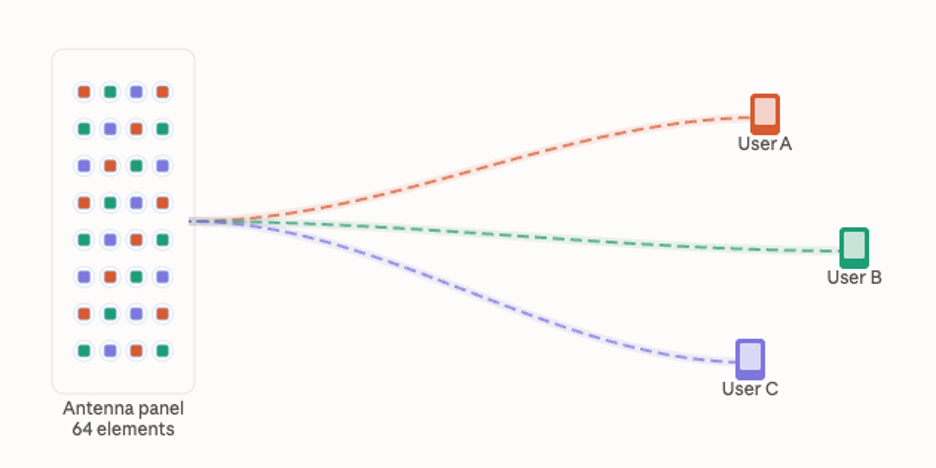
To better understand the merits, you can think of a massive MIMO system in the following image and four contexts:
1 – A radio with dozens — or hundreds — of antennas
A traditional cell radio has 2–4 antennas. A Massive MIMO radio has 32, 64, or even 192. All those antennas work together as a single smart panel.
2 – It shapes a focused beam — not a broadcast
The radio measures the exact path from each antenna to your phone, then slightly staggers the timing of each element’s signal. The waves add up (constructively interfere) only where your phone is. Everywhere else they cancel out.
3 – Multiple beams, multiple users, same frequency
Because each beam is spatially isolated, the radio can serve several phones simultaneously on the exact same frequency channel. This is called spatial multiplexing — it multiplies capacity without using more spectrum.
4 – Why it matters for venues and dense networks
A stadium with 60,000 fans all demanding bandwidth is a perfect Massive MIMO environment. The narrow beams concentrate signal exactly where people are — row by row — and reduce interference between sections.
The Nutshell
The combination of 5G SA and its wide channel bandwidth combined into Massive MIMO Beam Forming will, without any doubt, radically change the future stadium designs and the future stadium performance. Less infrastructure, simpler designs, less power, less space, and increased mobile performance. What’s not to like?
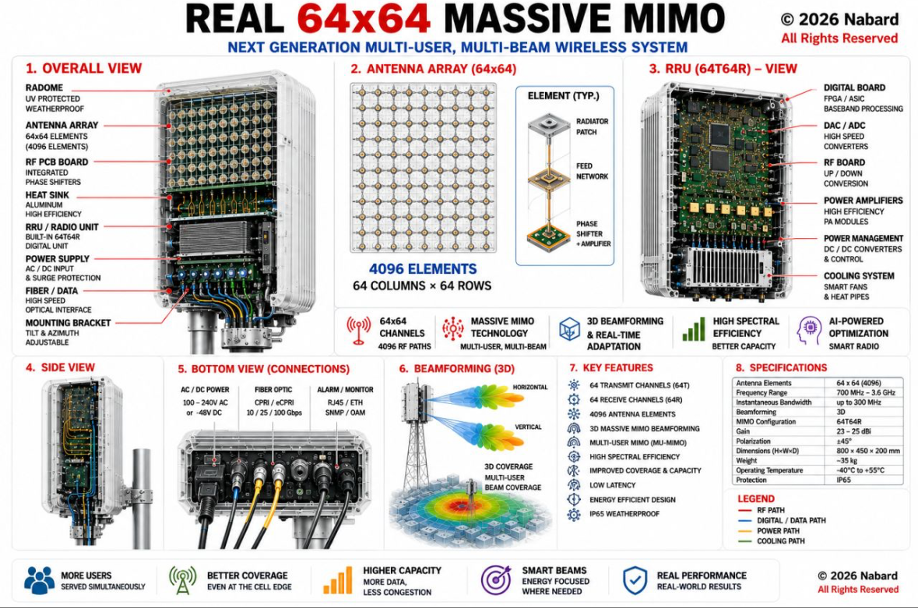
The innerworkings of a Massive MIMO antenna are fascinating, and it’s important to note again that it is much more than just and antenna, it is many antennas, with many amplifiers, and it is has a layer of intelligence that knows about the mobile devices it can see (essentially) so that it can adapt dynamically.
With credit to Nabard Muhammad for the following image – it gives you a bit of insight into a Massive MIMO radio.
Is There More Spectrum Coming?
The ongoing demand for capacity is constantly pushing the demand for more spectrum. As seen above, even as late as this year saw more spectrum acquisitions happening. Auction 113 resulted in some $3.5 billion of purchases.
Under the current U.S. administration, the bill known as the One Big Beautiful Bill (July 2025), is helping the U.S. spectrum markets by revising the general authority of the FCC and mandating 800MHz of new commercial spectrum.
These tables provide an overview.
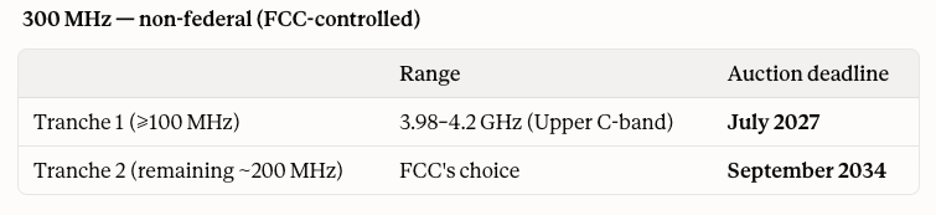
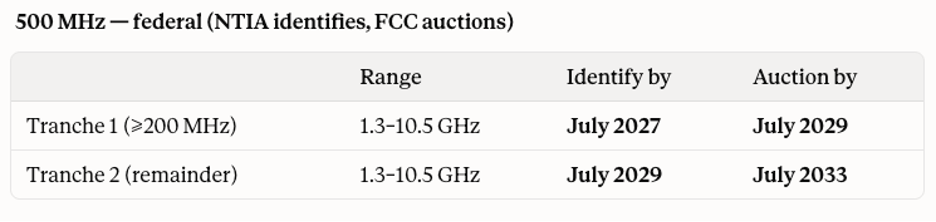
Exactly how each these areas of spectrum will be licensed is yet to be concluded, however some of the terms are explicit in certain areas such as “full-power commercial licensing”. These types of declarations result in an approach that would not be conducive to shared low power spectrum models such as that of CBRS spectrum (the shared private wireless spectrum).
So, the current landscape, if you wish to follow, looks like:
AWS-3 (Auction 113) — done. Closed June 2026, raised $3.57 billion. This was the first FCC spectrum auction in four years and mostly cleaned up previously defaulted licenses rather than adding new pipeline spectrum.
Upper C-band — the live one. The FCC has adopted its auction plan: 160 MHz at 3.98–4.14 GHz, 3,248 flexible-use licenses across the contiguous US, auction closing by July 2027. Winners pay transition costs plus incentive payments to satellite incumbents. Service can start in the top 75 markets December 2030, remaining markets July 2031. The strategic logic is a 440 MHz contiguous “super band” at 3.70–4.14 GHz when combined with the existing Lower C-band — the same block the carriers already have deployed.
2.7 GHz — moving faster than expected. NTIA’s relocation plan for 2.69–2.9 GHz cleared the Spectrum Relocation Fund Technical Panel, unlocking agency funding for engineering studies, and is in a 60-day Congressional review window. This looks like the leading candidate for the federal Tranche 1 identification due July 2027, framed publicly as a 6G play.
That’s all for this Episode!